
DevlogRelease5 min read
The first alpha
Everything that went into Felucca's first playable alpha in one place: a way in from the main menu to the quay of Aquais, a real player's interface, skills you raise by using them, crafting and town markets, houses on your own plot, parties and guilds, the rules of PvP, thirty-one kinds of creatures with their own 3D models, characters dressed in what they actually wear, and a fight you can read at a glance.
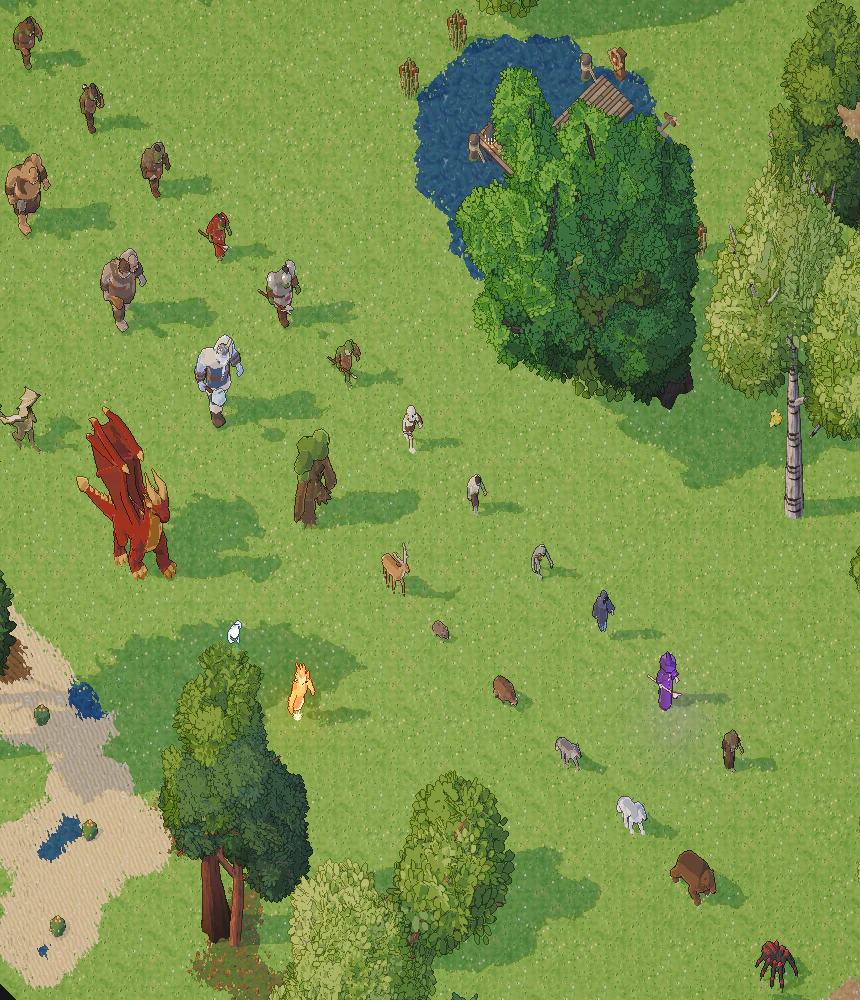
For the last few weeks Felucca has been built towards one goal: a build that strangers can connect to, play for an evening and come back to. That build is now together. Instead of a dozen small posts, here is all of it in one place, from the main menu to the dragon in the far wilds.
It is an alpha. Numbers will change, things will break, and some of what you read here will look different by the next test. That is what the test is for.
Getting in
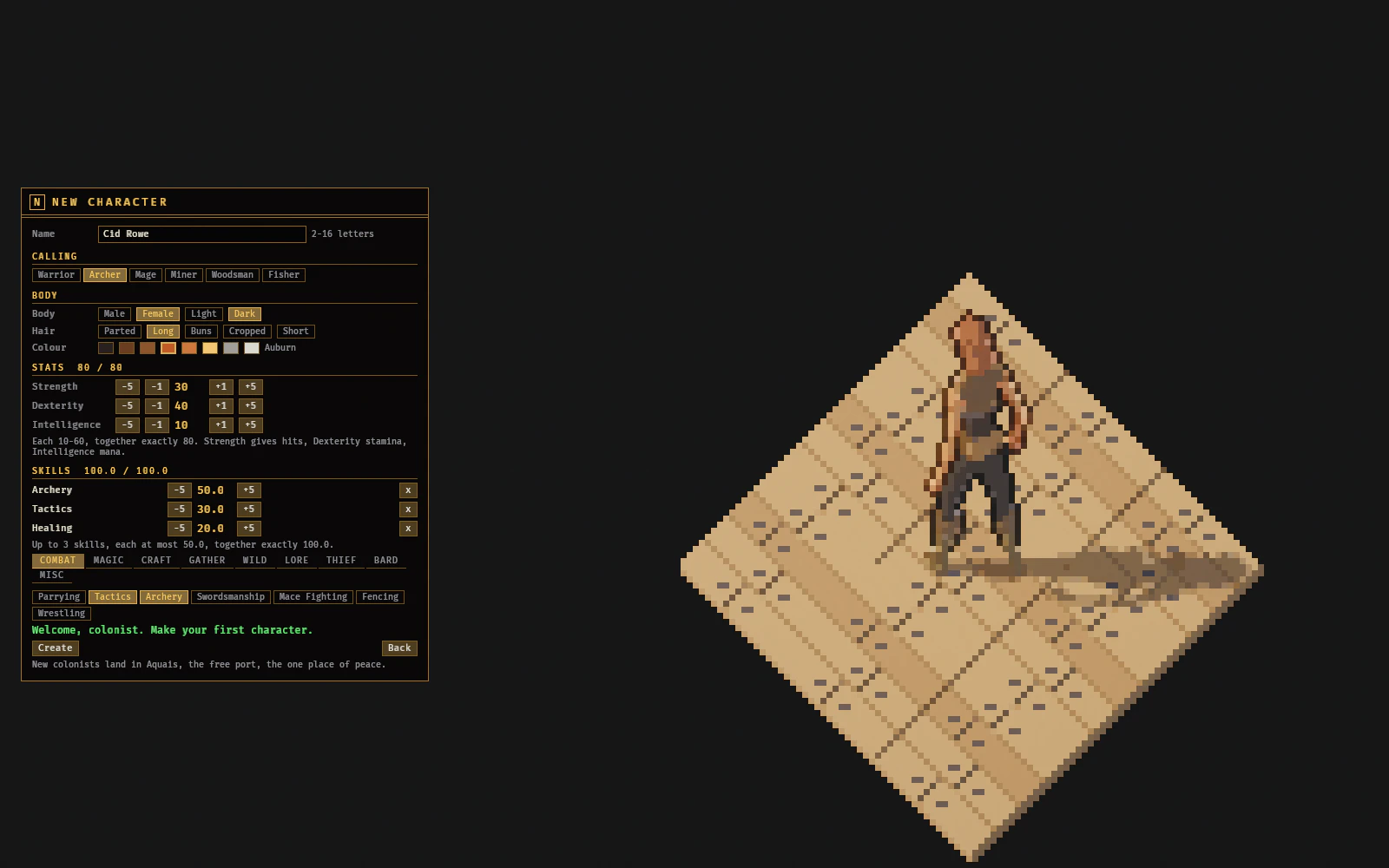
The client now starts on a main menu. You register with an alpha key, and your account keeps your characters and their names yours. You make a character by choosing a body, stats and starting skills while it turns in front of you, and you step off the boat on the quay of Aquais, the colony's free port and its only place of peace. On the character list each character now stands in what they actually wear.
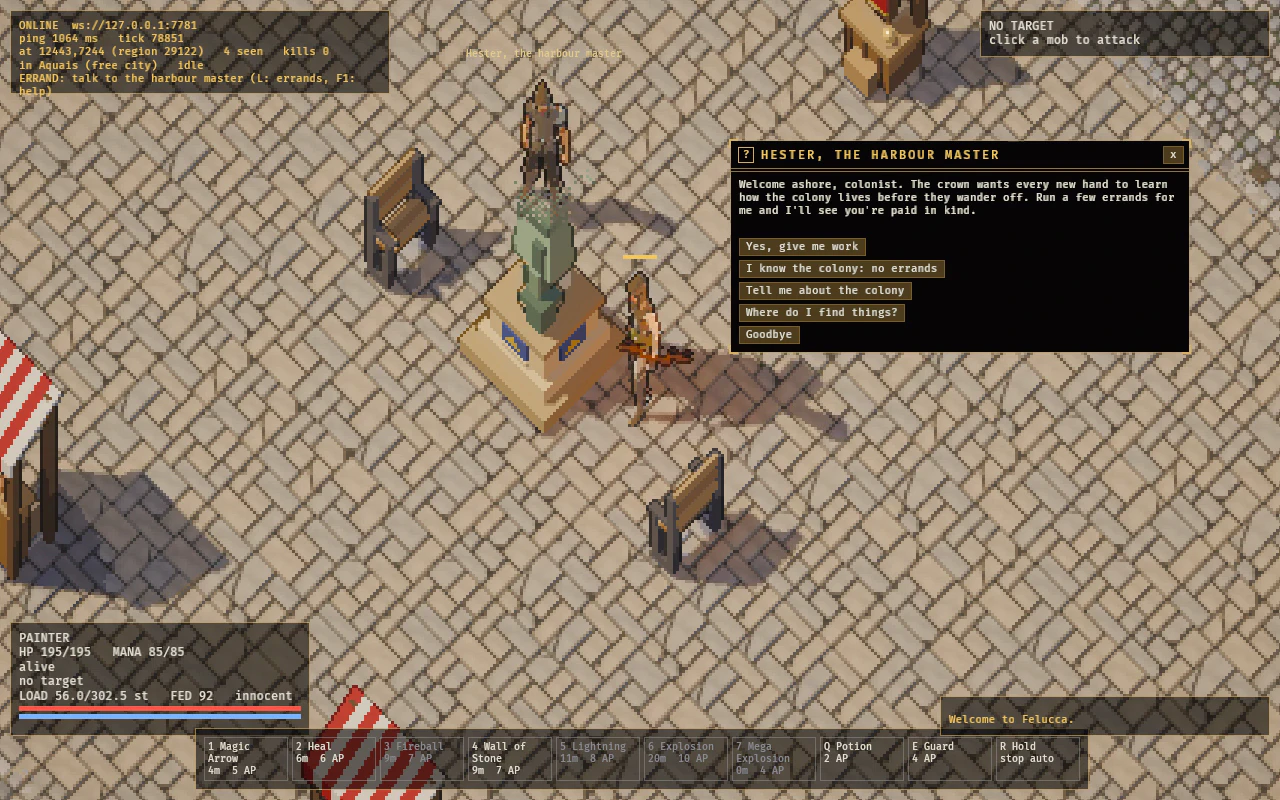
Aquais has people in it now: bankers, healers, smiths, innkeepers, and guards who deal with criminals. The harbour master meets every new colonist on the quay. Their errands walk you through the colony one step at a time: where to find work, how to sell, where to eat.
A player's interface
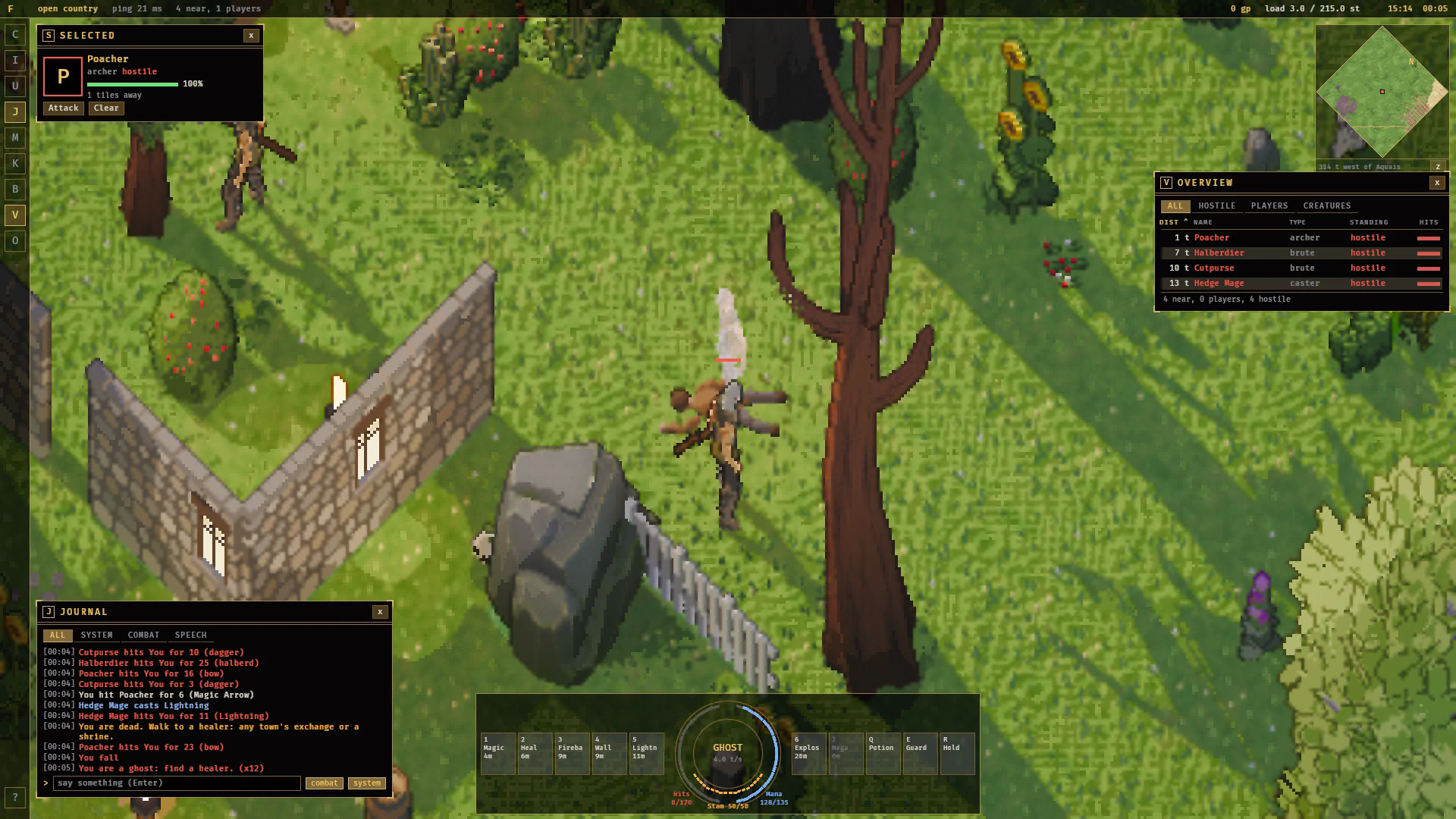
The game used to show its state the way a developer reads it. Now it has an interface built on the design we chose early on: dense windows in smoked glass with thin brass lines, numbers in columns, and colour only where it tells you something.
- A HUD with a top bar (where you are, your ping, your coin and your load), a ring for hits, mana and stamina, spell slots beside it, and an overview of everyone near you, which you can sort and filter. It now reaches 40 tiles, so even at the farthest zoom nothing in view goes missing from it.
- A real paperdoll: drag gear onto it to wear it, off it to take it off. Every item has a picture, a tooltip with what it does in plain words, and a right-click menu.
- Skills shown as levels with a bar to the next one.
- A journal and a chat you can talk from and scroll back through.
- A world map that plans your road and tells you how long the run will take.
Containers work like you would expect. Drag a stack and the game asks how many to move, all of it by default. Drop a stack on another of the same kind and they become one pile. The pouch has its own window, smaller than the backpack, and pictures keep their size in it. Things you drop on the ground lie in a bag anyone may pick up, and the bag disappears once it is empty.
You become what you do
There are no classes. Swing a sword and your swordsmanship grows, cast and your magery does, sew and you become a tailor; your stats follow the skills you use. Seven crafts make the colony's weapons, armour, clothes, bows, potions and scrolls, and everything you wear wears out.
Trees, rocks and ore veins are worked until they are spent. Then they fall or crumble, and a while later they come back: rocks whole, trees from a sapling. Doors and gates open and close with a click and swing on their hinges.
Markets that move
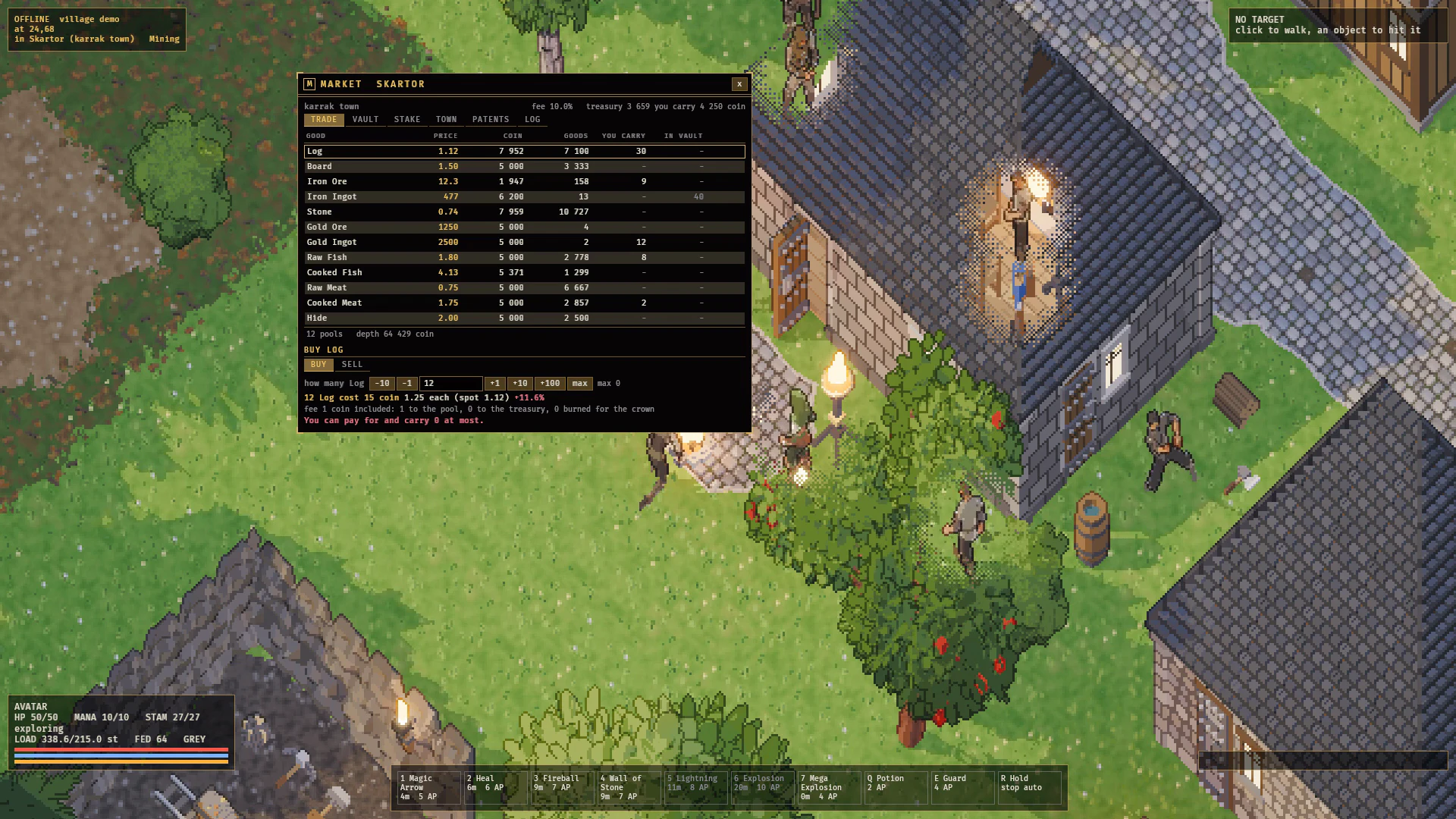
Every town runs its own market, and the price of a log there depends on how many logs are already in it. Before the alpha we let bots play the colony for simulated days and a simpler model play it for weeks. The first runs were grim: tools broke every few minutes, the scarcest markets were emptied by a single backpack, and nobody earned a coin. Tools now last much longer, every market starts deep enough that one load moves its price by a fraction, and Aquais always buys a few loads an hour near its starting price.
The exchange only takes what lies right in your main backpack. What you wear and what you keep in other bags is never sold by accident.
A house on your plot
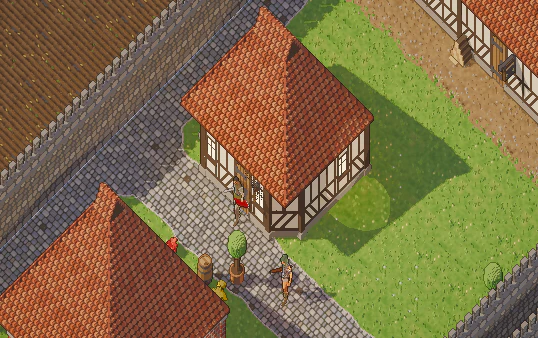
Hold a plot in a town and you can have a house built on it. Pick a design at the exchange, carry the stone and timber to your plot, watch it rise in four stages, then lock the door and fill it.
Friends, guilds and the rules of PvP
Whisper to anyone wherever they are. Talk with your party, guild and allies, or call out on the region and trade channels. A party's health bars follow you across the map, and a guild's tag shows over every member's name.
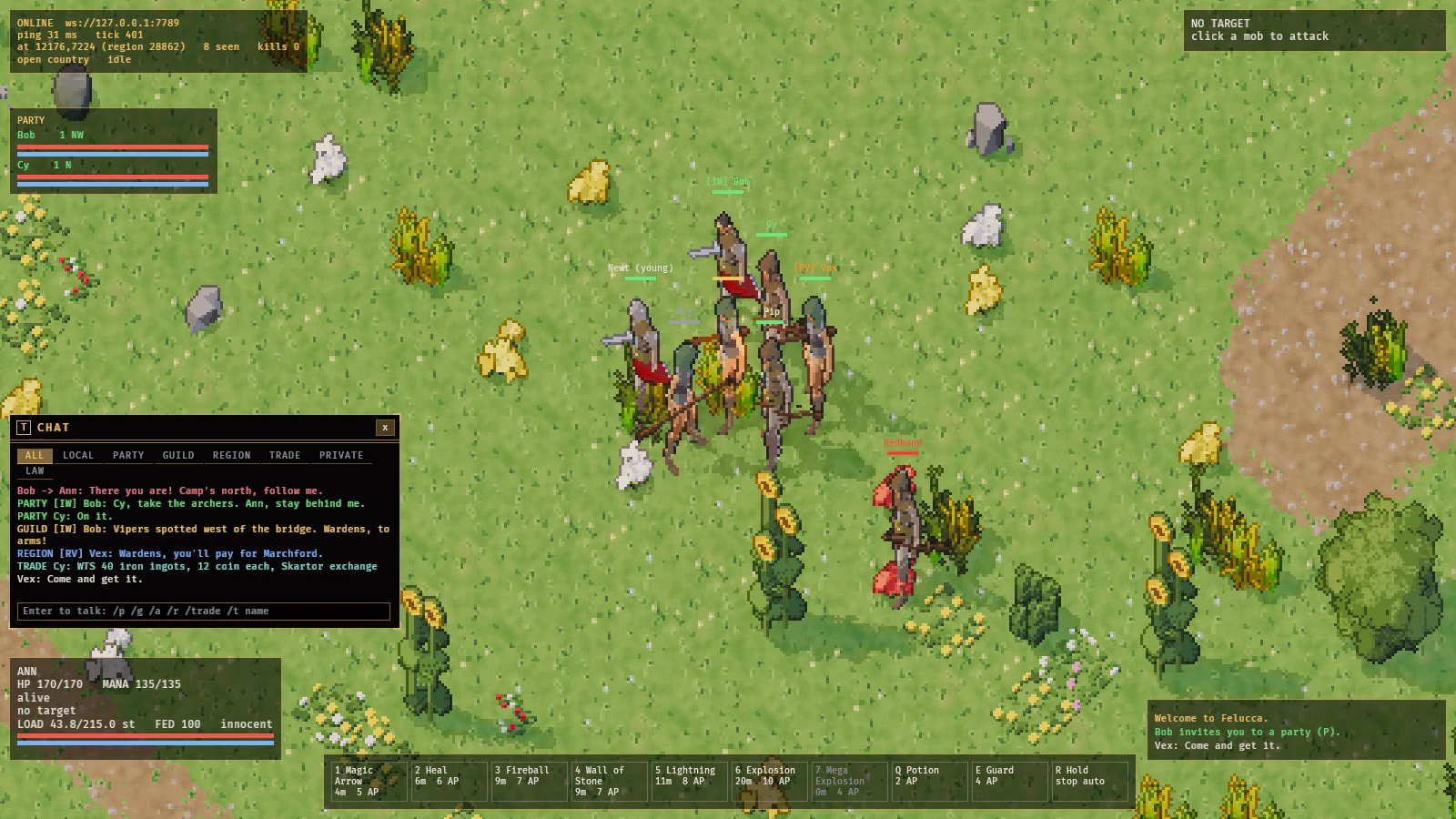
Full loot and open PvP stay, but now they have consequences. Attacking an innocent makes you a criminal, killing one is a murder count, and five make you a red murderer whom anyone may kill and the guards hunt. New colonists are protected for their first hours, nobody is killed at the healer, and the isles and the wilds keep no law at all.
The wild is alive
Thirty-one kinds of creatures now live across Felucca, placed by the world atlas: deer, boars and the odd wolf pack near the towns, orc bands and road patrols in the March, skeletons by the old battlefields, spiders in the woods, harpies on the hills, and in the far wilds trolls, ettins, wraiths, drakes, fire elementals, frost giants and an ancient dragon. Each fights its own way. Wolves hunt in packs, orc archers keep their distance, shamans heal themselves, and drakes and dragons breathe fire. Nothing out there carries coin. What they leave is the stuff of crafting and trade: hides, bones, silk, scales, essences, and now and then a gem.
They used to be coloured capsules. Now every one of them has its own 3D model, modelled in the game's low-poly style, rigged and animated: they walk, attack, cast, flinch when hit and die. Fliers hover, the fire elemental and the wisp glow, orcs and skeletons fight with the weapons in their fists, and the dragon breathes its fire from its jaws. What they leave behind now rots away after a while, and a body opens with a click anywhere on it.
Everyone wears what they wear
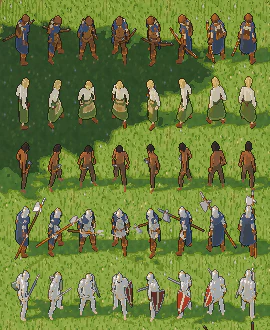
People are no longer the same two outfits. Every player, townsperson, guard and bandit is one body dressed in the real model of each piece of clothing and armour they wear, with the real weapon, tool or shield in their hand. What is hidden under clothes isn't drawn at all, so a dressed character costs less than half of what it did.
A fight you can read
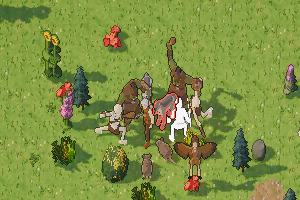
Fights in a crowd were hard to follow, so the target now stands out. What you fight gets a red outline, and whatever is under your mouse a light one. Both follow the whole silhouette and show through anything that stands in front of it, so a wolf behind a bush or an orc behind your friend stays visible. Everyone struck flashes white for a moment and flinches.
Fair play, game masters and AI players
Before strangers connect, the server learned to keep its own books, to give scripts and people the same limits, and to let game masters fix a tester's problem inside the live game.
Felucca was built for automation from day one. An AI assistant such as Claude can now play a character through game tools: walk, chop, mine, fish, trade at the markets, eat and fight. It plays by the same rules and limits as everyone else. Script authors get a full protocol reference and a bot to start from.
What's next
The alpha is about finding out what breaks and what is no fun. Tell us in the comments below.
Comments
Join our Discord →Comments are the replies to this post’s thread in our Discord forum. They appear here a few seconds after they are posted.
The discussion thread opens on Discord shortly after a post goes live.