DevlogFeature9 min read
Caravans, a curve and a vault
A long read about Felucca's economy: why there are no portals, how each town prices its goods on a curve, where a trade's fee goes, how land is held by stake, how a vault is raided and stolen goods are marked, and the holes our own trading bots found before any player did.
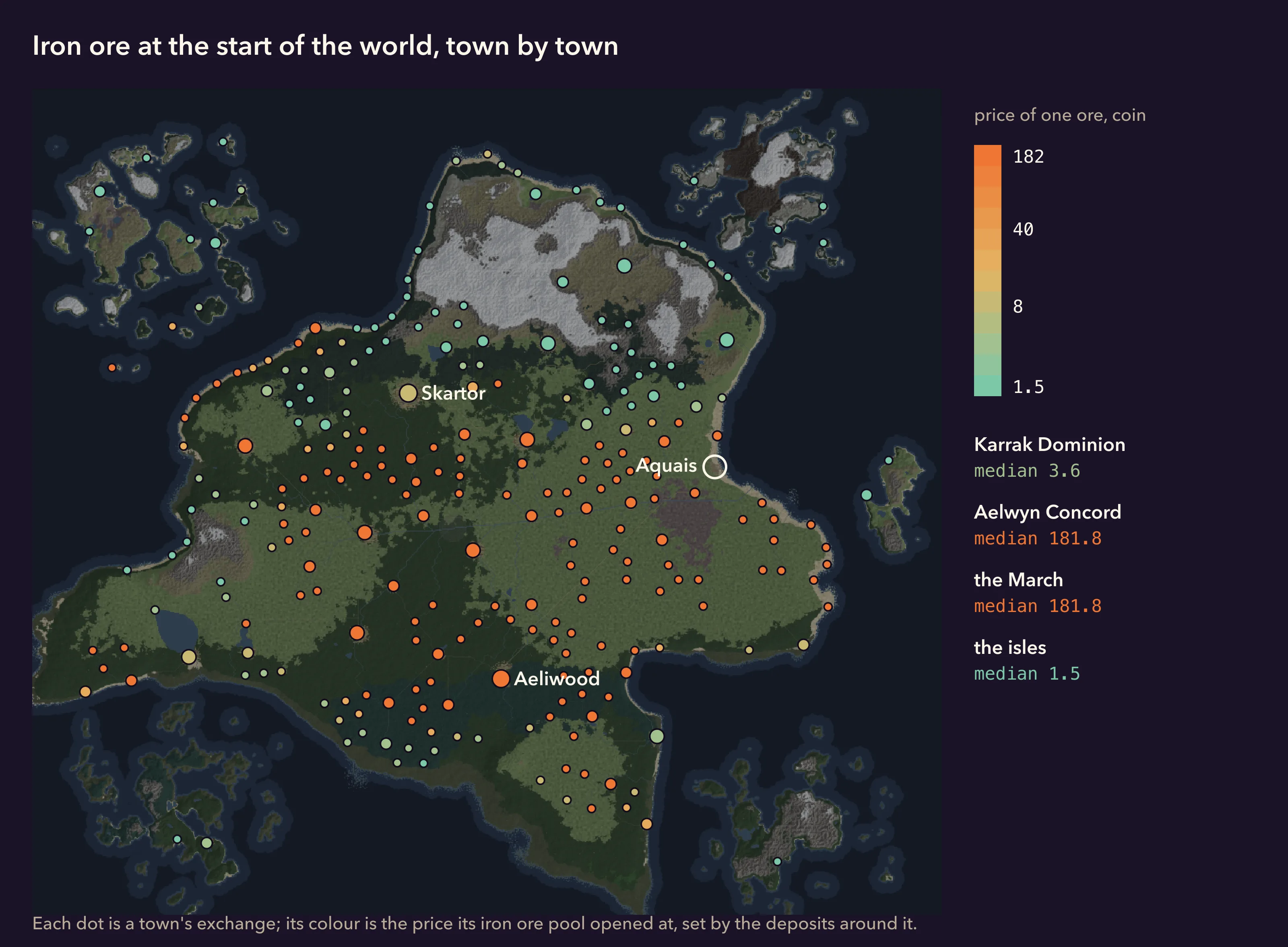
Every MMO economy is a story about distance. If you can carry a mountain of ore across the world in a second, there is one market, one price and nothing to do between gathering and spending. Ultima Online found that out early: the Recall spell and bank cheques made Britain's bank the only place that mattered. Felucca goes the other way. There are no portals and no paper money. A tile is a metre, running from one coast to the other takes about an hour, and everything you carry weighs something, coin included.
This post is about the economy we built on top of that: what you gather, how towns price it, what you can own, what can be taken from you and how. It is long, it has a few numbers in it and a little code. Every picture is either the game itself or drawn by our own code from the game's data; the cover is the price of iron ore in every town when the world began.
A colony, not a kingdom
Felucca is the land of the orcs, and the people in it are colonists. Aquais, the free port on the east coast, is held by the mainland: it is the one place where nobody may fight, and the one place that mints coin. The two factions, the Karrak Dominion in the north and the Aelwyn Concord in the south, are not kingdoms sent from home but colonial blocs that grew out of trade and greed.
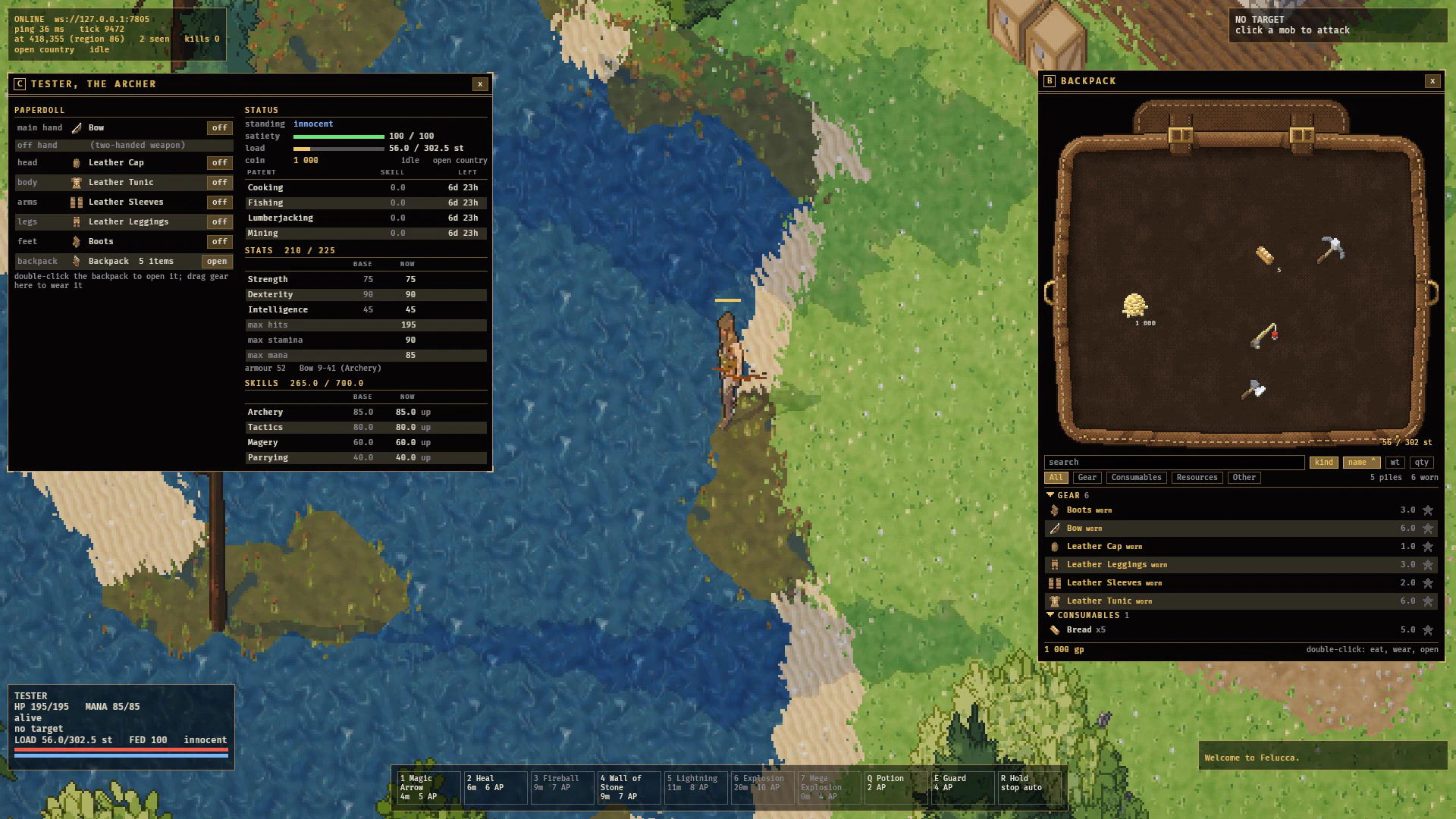
The colony did not start from nothing. The colonial company seeded every town's market with goods and coin, and every colonist lands in Aquais with a thousand coins, a pickaxe, a hatchet, a fishing pole, five loaves of bread and seven days of work permits. After that, they are on their own.
Scarcity is geography
The world atlas already decides where things are: iron, gold and granite in the Karrak mountains, bow woods and grain in the Aelwyn forests, the richest of everything on the lawless isles. When a town's market opens, its starting price for each good comes from how much of it lies around the town, counted from the atlas' deposits and the ground: mountain rock for stone, forest for timber, water for fish. Plenty nearby makes a good cheap, none within reach makes it up to thirty times dearer than its base price.
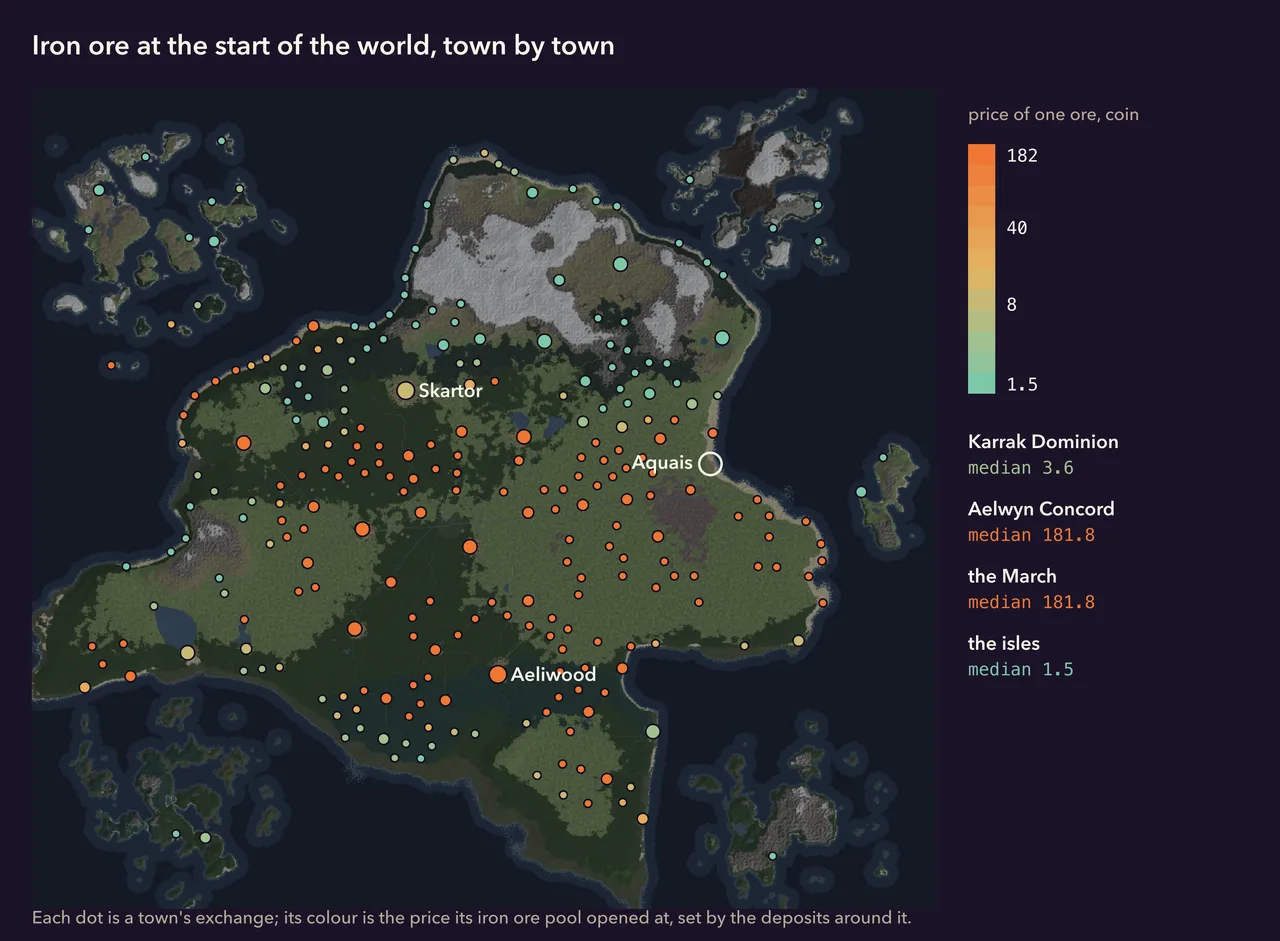
The result reads like the map's politics. A lump of iron ore costs about 3.6 coins in a Karrak town and about 180 in an Aelwyn one; across all 269 towns, a block of stone opens anywhere between 0.75 and 90 coins. Nobody set those prices by hand. They are where trade starts, not where it has to stay.
Coin is heavy
Everything you carry has weight in stones, and a strong colonist carries about 390 of them. Coin too: 25 coins weigh a tenth of a stone, so a hundred thousand coins is a full load on its own. There are no cheques yet. If you are rich, your wealth sits in a town's vault or walks with a guard.
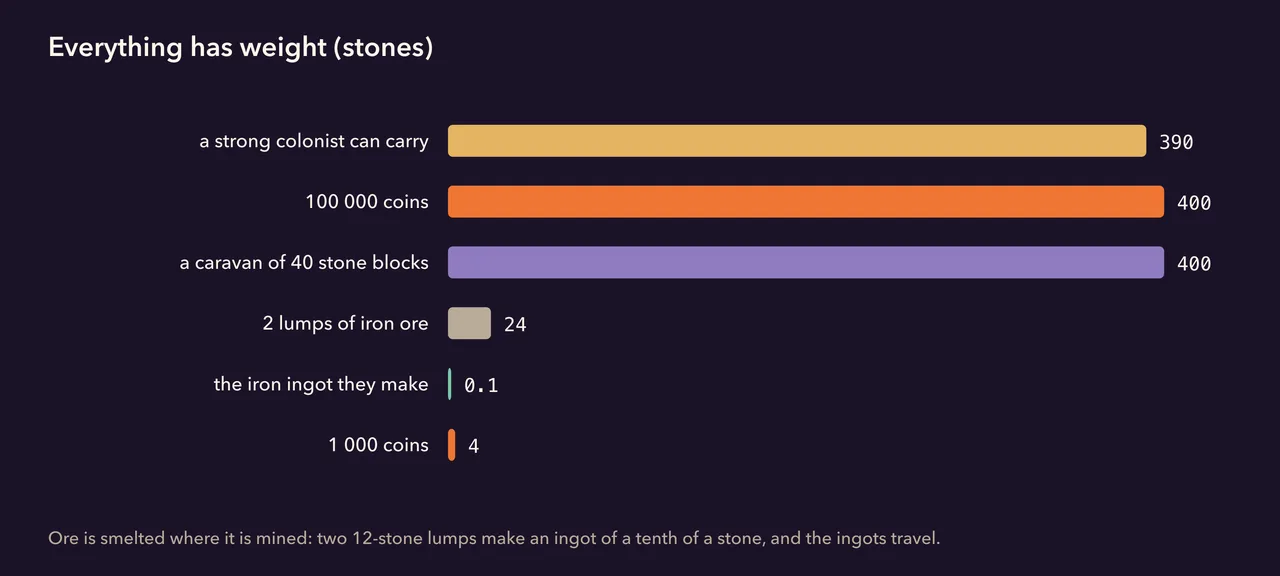
Weight also decides where work happens. Two lumps of iron ore, twelve stones each, smelt into one ingot of a tenth of a stone, so ore is smelted at the mine and ingots travel. Stone is the opposite: heavy, cheap where it is plentiful, and only worth a caravan when somewhere needs it badly.
A market without merchants
Each town trades each good against coin in its own pool, and a pool is the simplest market there is: a heap of coin and a heap of goods whose product stays the same. Buying takes goods out and puts coin in, so the next unit costs a little more; selling does the opposite. This is the curve decentralised exchanges call x · y = k, and it has two properties we wanted.
There is always someone to trade with. A small world's markets usually die of "nobody is buying right now"; a pool always answers. And a big order moves the price where you make it. Buying ten blocks of stone in Skartor at the start costs 13.4 coins each; buying four hundred costs 17.5 each, and the next buyer finds 21.1:
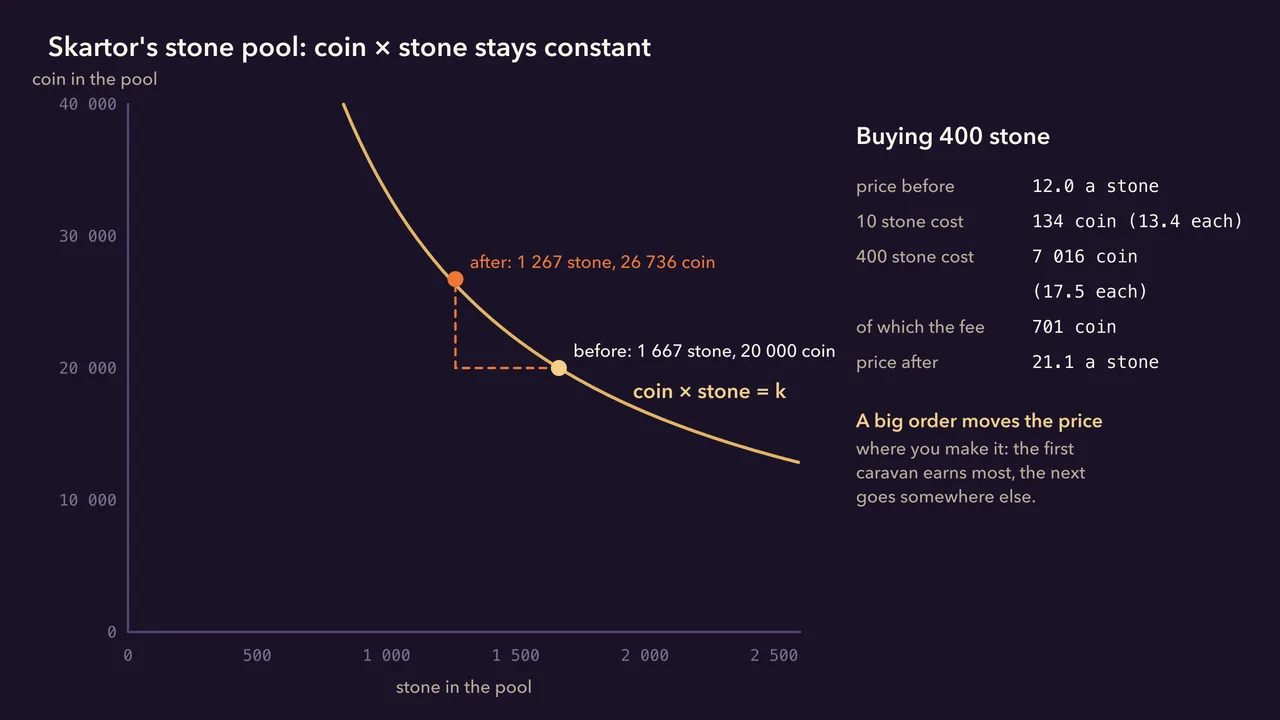
That is slippage, and it is the point. The first caravan to unload in a town where stone is dear earns the most; the second is better off going somewhere else, and caravans spread over the map by themselves.
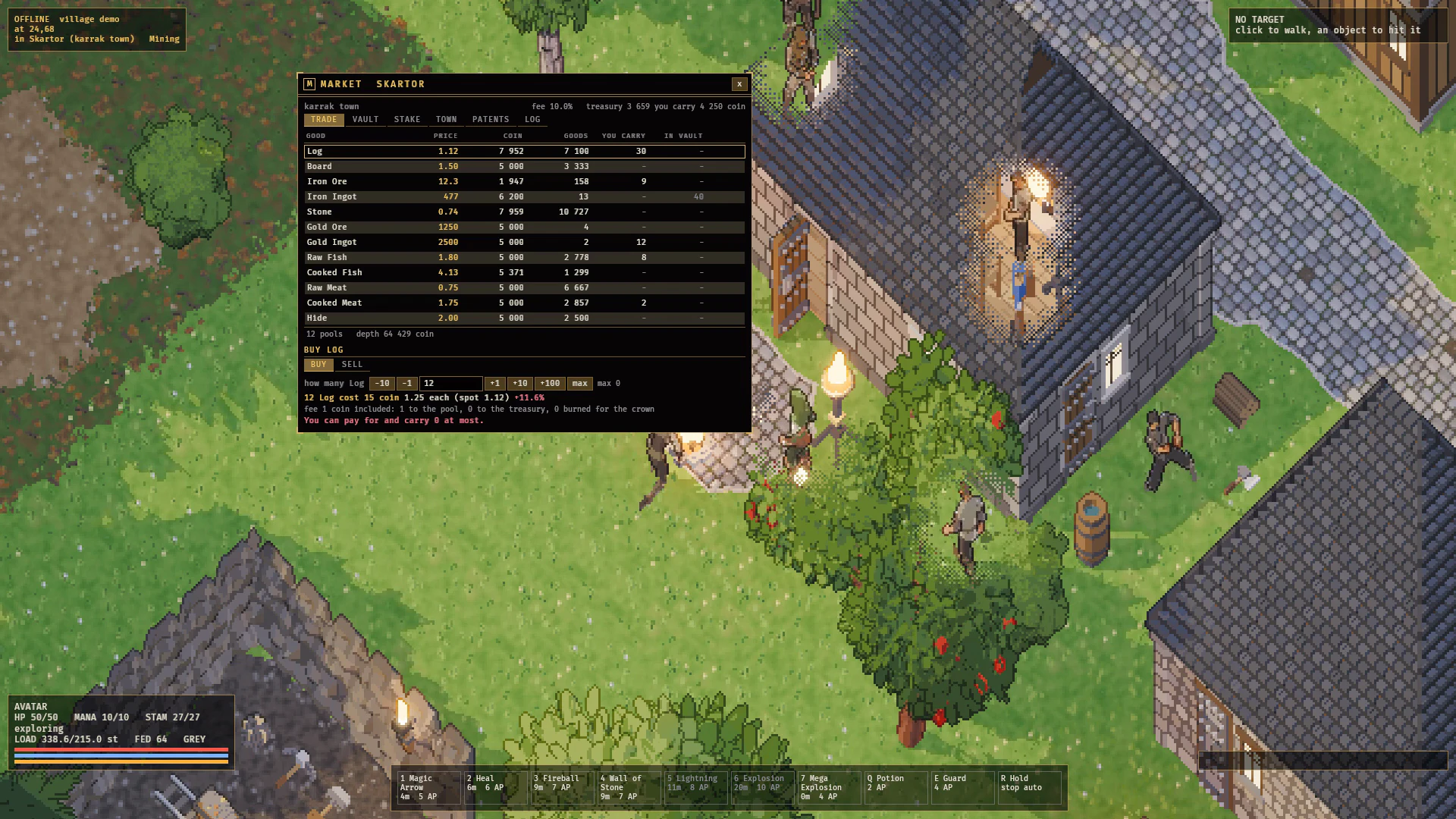
You trade by count: you say how many you want to buy or sell, and the market tells you what it costs or brings, fee included. The pool prices an exact count, rounded so it never loses:
/// The coin (fee included) that buys exactly `goods` units.
pub fn cost_to_buy(&self, goods: u64, fee: Bps, split: Split) -> Result<u64, PoolError> {
    // Coin that must reach the curve: goods·n / (gold + n) ≥ wanted.
    let (gold, left) = (self.gold as u128, (self.goods - goods) as u128);
    let need = (gold * goods as u128).div_ceil(left) as u64;
    // Then the fee on top, rounded up until the net is enough.
    let net = |g: u64| g - Fee::of(g, fee, split).total();
    let mut g = (need as u128 * BPS as u128).div_ceil((BPS - fee) as u128) as u64;
    while net(g) < need { g += 1; }
    while g > 1 && net(g - 1) >= need { g -= 1; }
    Ok(g)
}
Every trade also carries a limit, the most coin you will pay or the least you will take, and fails rather than fill worse than the window showed you.
The fee is the town's tax
Each trade pays a fee in coin, ten percent to start with, and it splits three ways:
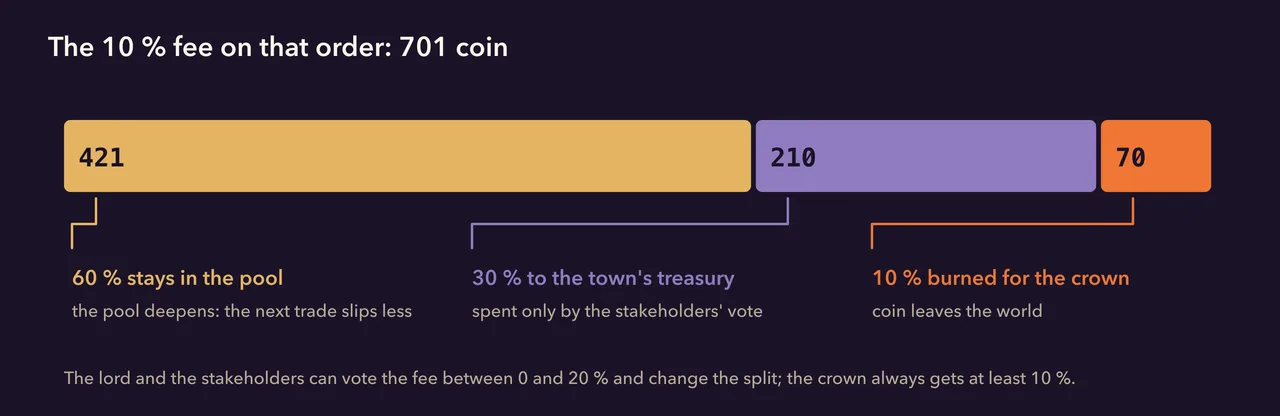
Most of it stays in the pool, so a market that trades a lot gets deeper and slips less. A share goes to the town's treasury. A share is burned in the mainland's name: coin that leaves the world for good, one of the ways money drains out of the economy as it comes in.
Aquais trades too, at pools the mainland seeded as deep as a capital's, but they belong to the mainland alone. Nobody can invest there, there is no treasury, and its share of every fee is burned.
Caravans close the gap
Put the curve and the distance together and you get trade. We let the game's own pools play it out: two real Aelwyn towns 792 tiles apart, stone at 1.8 in one and 90 in the other, and caravans of forty blocks.
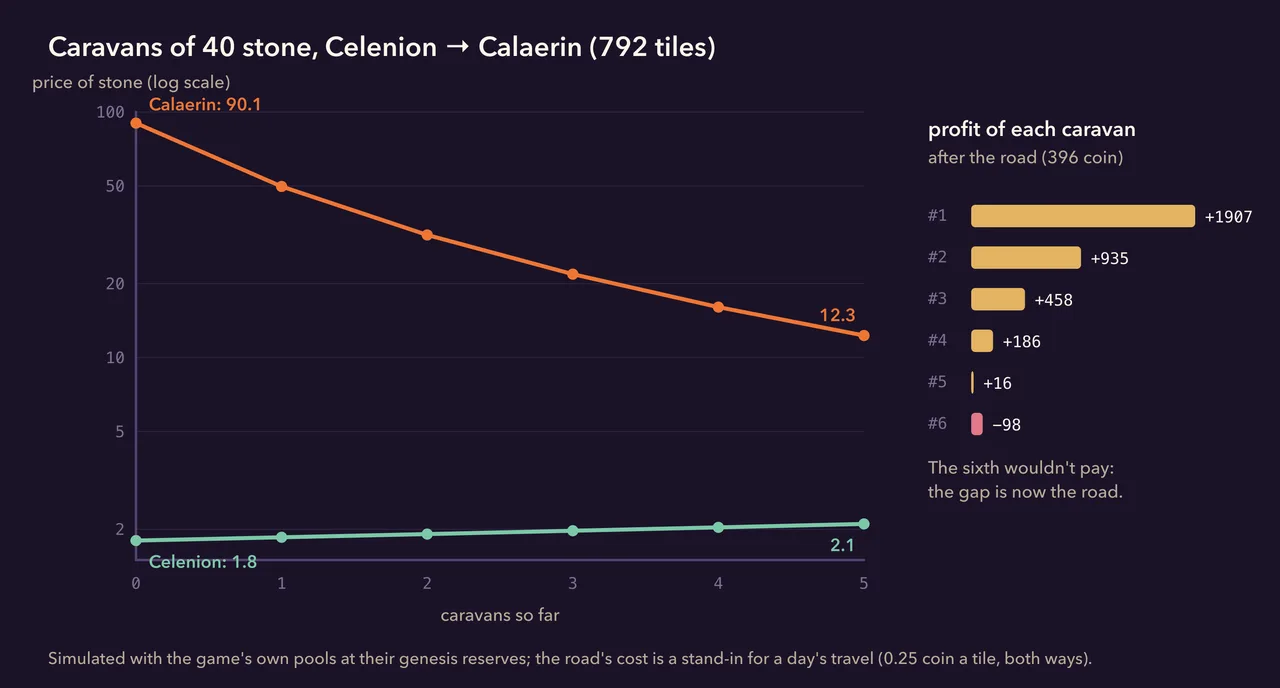
The first caravan clears almost two thousand coins after the road. Each one after it earns less, because it sold into a pool the last one already filled. The fifth makes sixteen coins and the sixth would lose money: the price gap between the towns is now just the cost of the road. That is what a market without portals is supposed to do. The gap never closes to zero, it closes to what it costs to carry the goods, and whoever carries them is paid for the risk on the way.
Land is held by stake
Anyone can put coin and goods into a town's pools in their current ratio and receive shares. Shares earn: every fee that stays in a pool makes them worth a little more. They are also how you hold land. A plot of a town needs a stake worth the plot's price, locked while you hold it. The lock is counted in shares, not coin, so later investors never dilute your claim, and the locked shares keep earning.
Stakeholders run the town. They vote, weighted by what their shares are worth when a vote starts, on the fee, its split, payments from the treasury, the plot price, the raid window, and who the lord is. A proposal is open for an hour, needs a fifth of the stake to vote and more yes than no, and once a town has a lord, the lord has to agree too. The lord cannot take the treasury; only a passed vote spends it. Conquest and vassal oaths are the next layer; for now a lord is elected.
One vault, and it can be broken
Everything fungible a town holds lives in one strongbox next to its exchange: the coin and goods of its pools, its treasury, and whatever people deposited there. For two hours each evening, the town's vulnerability window, that strongbox can be broken. It takes two to six hundred blows, so a raid is a party's work, or a powder keg's. Once it breaks it stays open for five minutes and anyone nearby can take what they can carry.
What is taken comes out of every claim at once, in proportion to how much of it could be taken:
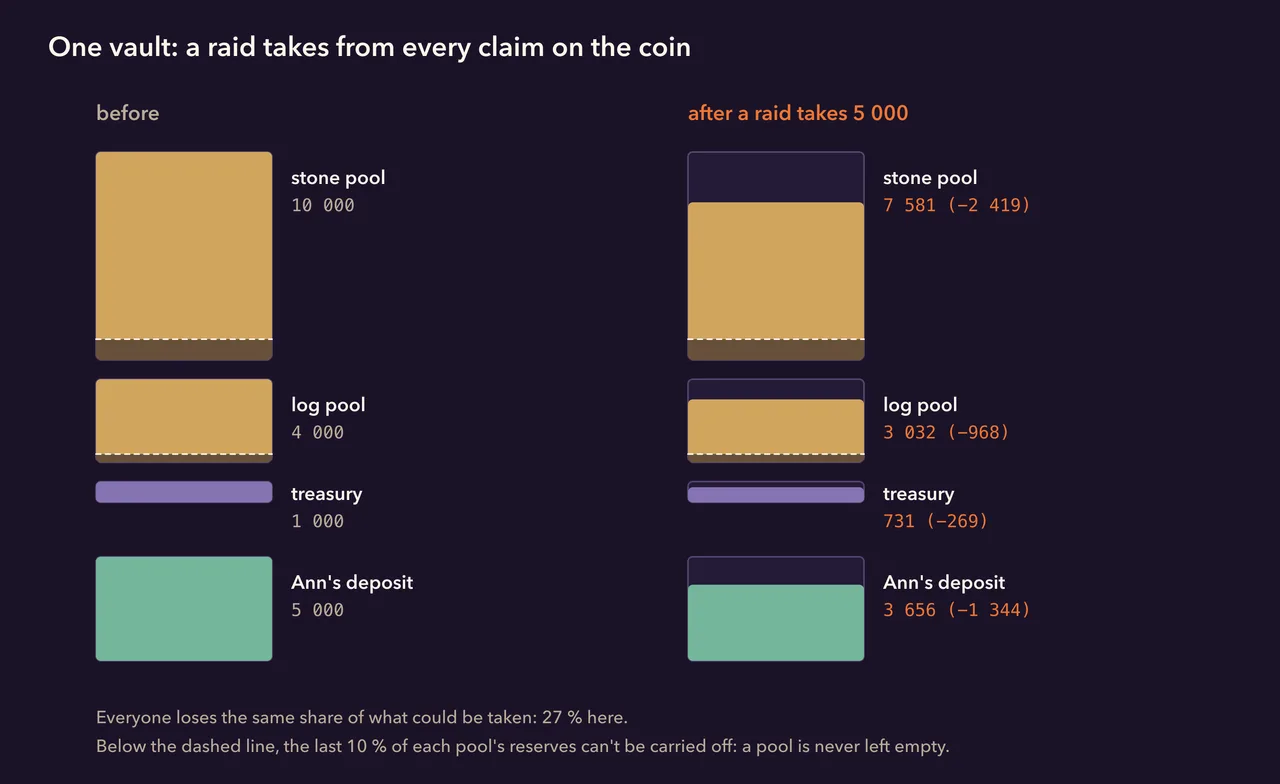
Taking coin out of a pool moves its price, so a raid on a market is felt by everyone who trades there afterwards. The last tenth of each pool's reserves can't be carried off: a raid can hurt a market but never leave it empty.
Stolen goods carry their mark
Goods taken from a vault are marked with the town they came from. Whoever carries marked goods is grey: anyone may attack them, anywhere, even inside a town's guard zone, where innocents are otherwise protected. The mark stays on the goods, not on the thief, so killing the raider and looting the corpse makes you the one carrying it.
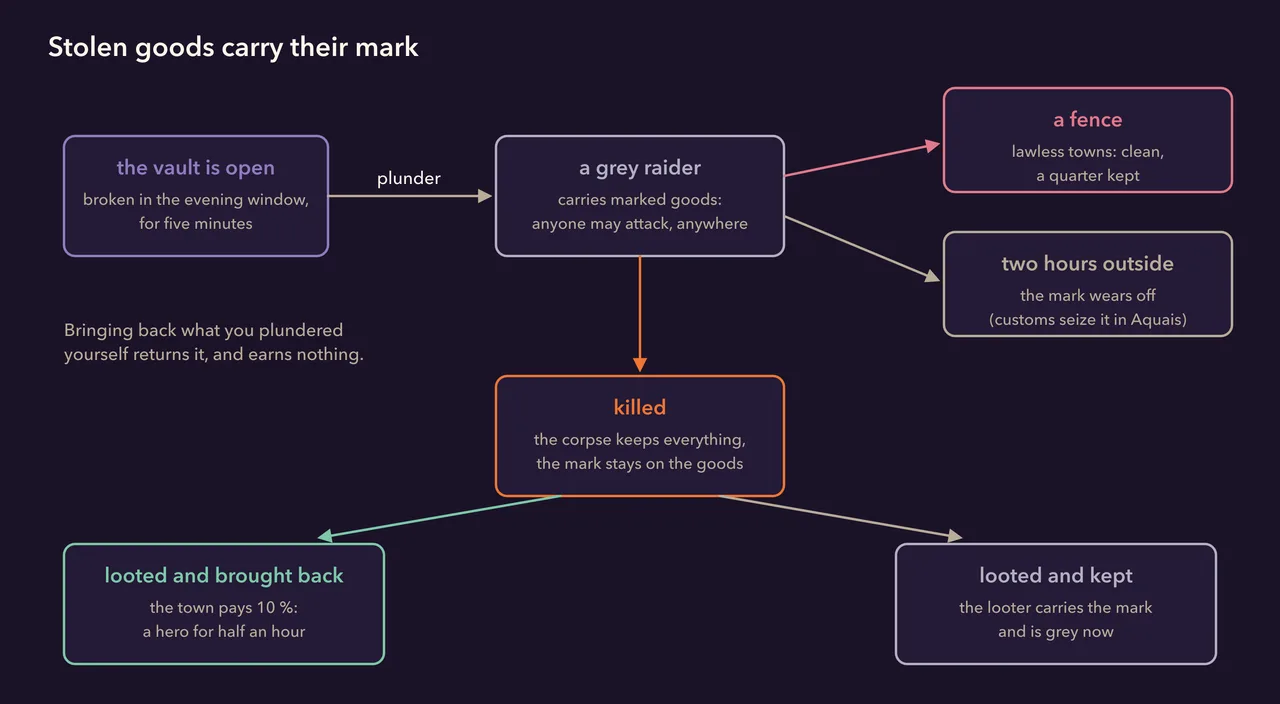
A thief has three ways out. Hold the goods outside every guard zone for two hours until the mark wears off. Find a fence in one of the lawless isle towns, which cleans them and keeps a quarter. Or carry them into Aquais, where the mainland's customs take them. Anyone who brings marked goods back to the town they came from returns them to the vault, keeps a tenth as a reward and is a hero for half an hour.
Death as it was
When you die, everything you carry and wear stays on your corpse, and you walk the world as a ghost. A ghost can only walk and talk, and nothing can touch it. It stands up again at a healer: any town's exchange, or an ankh or a virtue shrine. Whoever finds your body first can take everything on it; a corpse rots after twenty minutes, an animal's carcass after five.
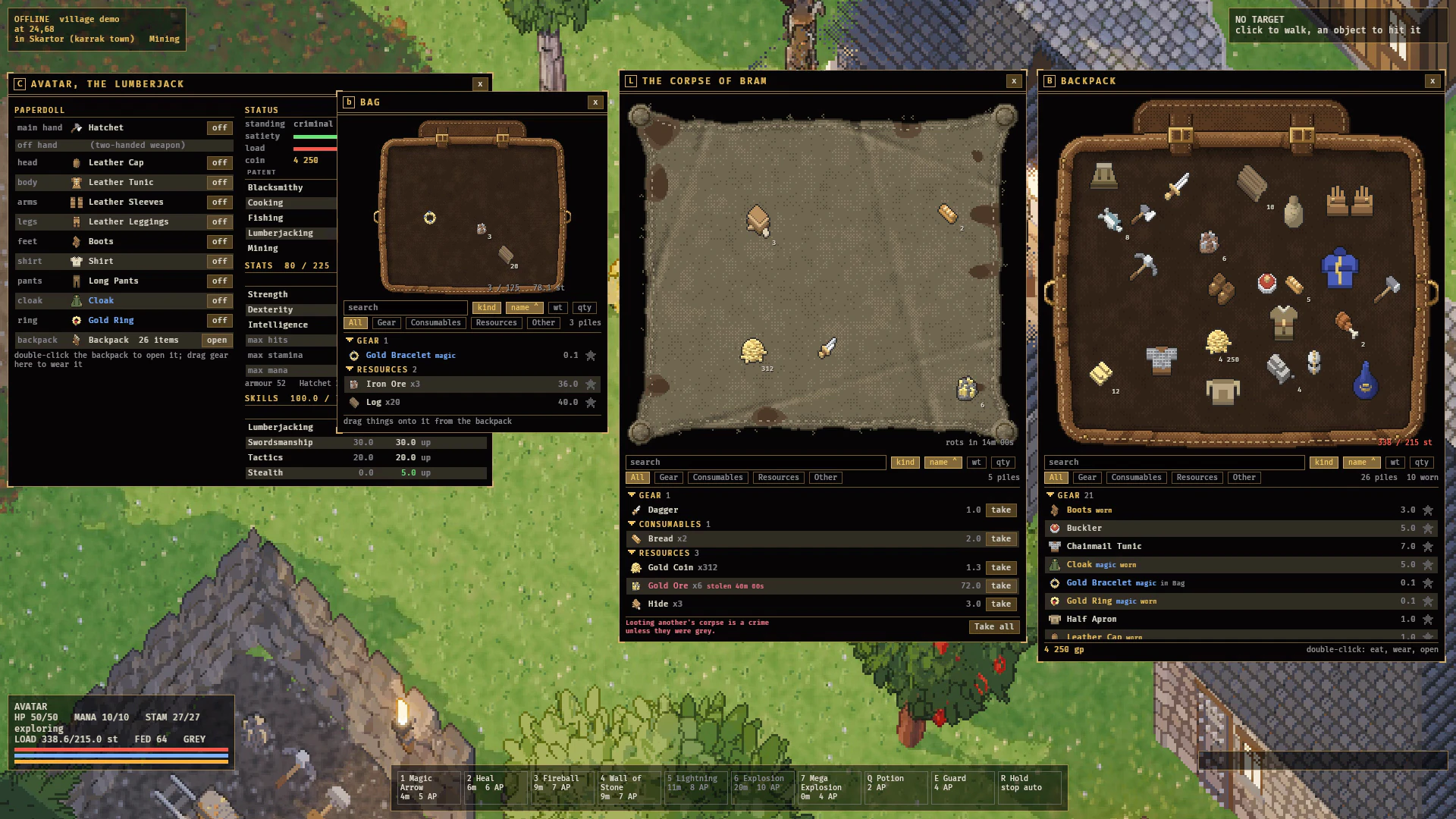
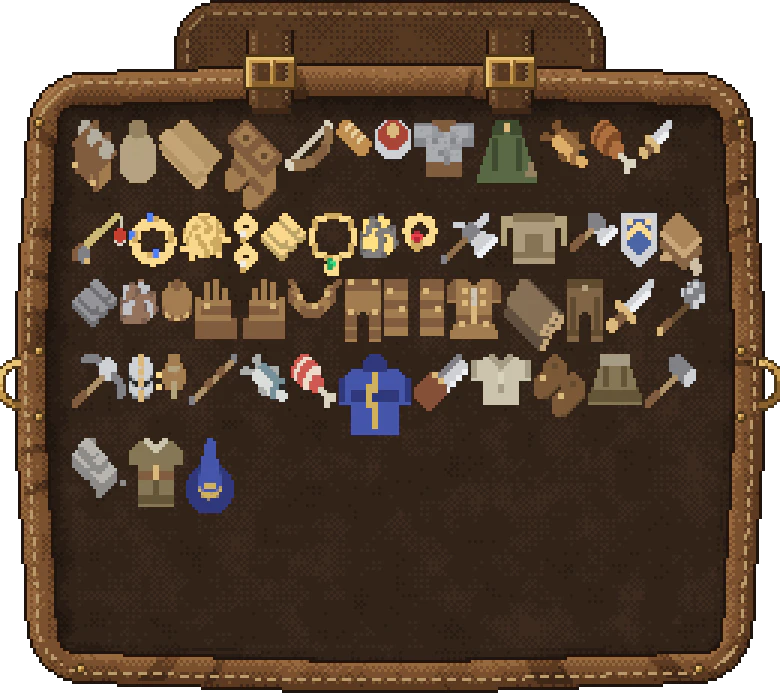
Looting another player's corpse is a criminal act, unless they were grey or the corpse lies in a lawless town. The new container window shows a corpse, your backpack and any bag inside it the same way, as an open pack with the things lying in it, with a list beside it to search and sort. Every item has a picture now:
A colonist costs upkeep
Gathering and crafting need a work permit per skill, two hundred coins for thirty days, paid to the mainland. Hunger runs while you play; at zero you are too hungry to work, and bread, cooked fish or meat bring you back. Tools wear out with use. Trees, veins and rocks run dry and grow back slowly, so what lies close to a town is soon worked out and the richer ground is farther away. Ten recipes so far turn logs into boards, ore into ingots, ingots into tools and raw food into meals, each at its station: a forge, an anvil, a workbench, a fire. Wolves, bears and deer roam the wilds as placeholder capsules until they have their own models; their carcasses give meat and hides.
The mint
Gold is a raw resource like any other: mined from gold veins, smelted into ingots, carried to Aquais and minted. The mint pays fewer coins per ingot the more have been minted, on a curve published in advance:
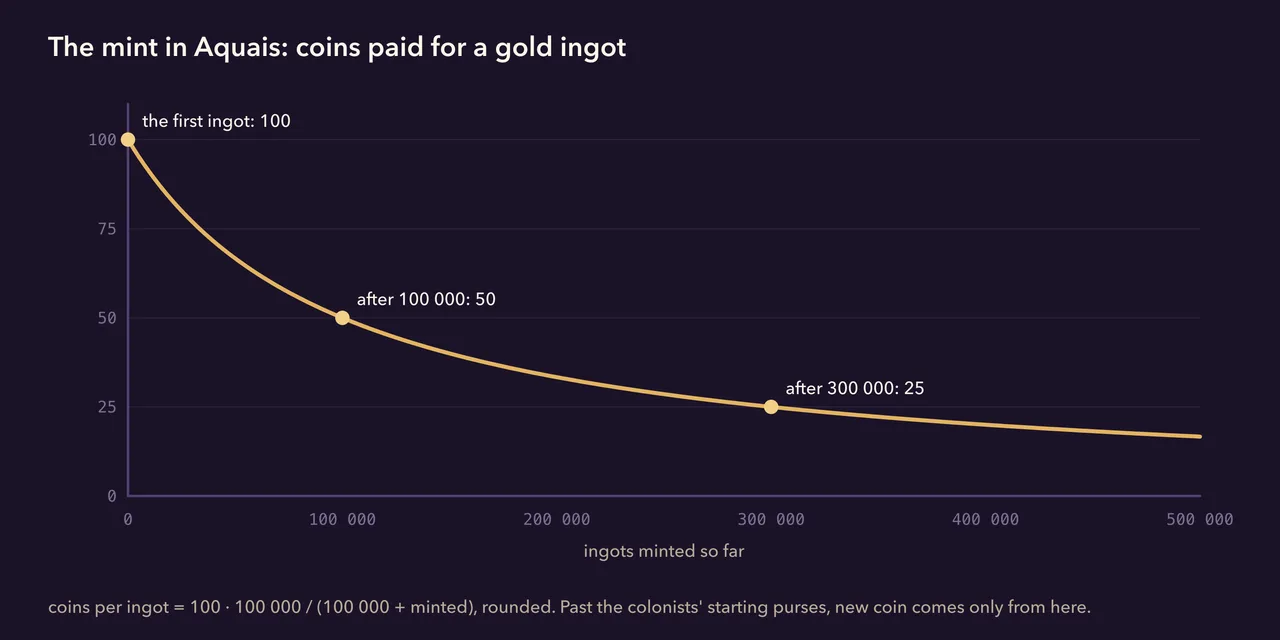
Past the colonists' starting purses, the mint is the only place new coin comes from. Monsters drop no coin, so a hunter earns by selling what they bring back. Aquais also takes coin out of the world: what you pay for permits and for goods from the mainland store is burned, and coin can be shipped home to the mainland, gone from the colony for good.
Our bots found the holes first
Bots have always been ordinary players here, and the economy got its own: miners, lumberjacks, fishers and hunters that gather and sell, haulers that buy where a market is cheap and carry to where it is dear, raiders that break vaults in their window, and guards that hunt grey players and return what they carried. We ran them against the server before any person played, and they found three holes in our rules:
- A thief could return their own loot. Break a vault, plunder, bring the goods back and pocket the ten percent reward as a hero. Now whoever plundered a vault earns nothing for bringing its goods back.
- A dead raider stood up at the vault. Every exchange is a healer, so a raider killed at a broken vault was raised beside it and plundered again, three times in one run. Now a ghost can stand up only half a minute after dying, and never at an exchange whose vault stands open.
- A raid could empty a pool. With the coin side at zero, nobody could trade that good again, and the next investor's shares would have been miscounted. That is why the last tenth of every pool now stays put.
Writing a script that works your colonist while you are away, and coming back to see what it brought home, is a way to play we want to support, not police. The same rules apply to everyone; the bots just found where they were broken sooner.
What is not there yet
This is a first version. Corpses and the banks of trees and veins live in the server's memory only, so a server failover loses them; they will move to the database. City-backed cheques, direct trade between players inside guard zones, pack animals and carts, building on your plot, and the lord-and-vassal layer are the next things we are designing. Every number in this post, from the fee to the weight of a coin, will move once people play. The full design and all of its rules are in the economy design doc.
Comments
Join our Discord →Comments are the replies to this post’s thread in our Discord forum. They appear here a few seconds after they are posted.
The discussion thread opens on Discord shortly after a post goes live.